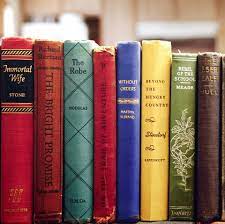
Books: First Lie Wins. A Novel by Ashley Elton. 2023

It is a book about a female con artist who is controlled by a mysterious Mr. Smith who instructs her to do various jobs and defines her marks. The protagonist does not know who is her Master. The plot follows her relationships with her most current mark, Mr. Smith and some “helpers” and antagonists. OK, so far so good. BUT – the plot is so arbitrary and incredible that a self-respecting reader would get very annoyed and offended by the stupidity of the whole thing.

Here is the heroine talking: “I shove a few fries in my mouth while I consider my next move.” This is exactly what the author was doing while writing this novel…The protagonist has about ten other aliases for her previous “jobs” and they are all called upon when something in this outrageous plot has to be motivated.

I found this title on the best-seller list and it was an editor’s pick on Amazon, and a book-club selection! It is either a symptom of the enormous power of advertising or the stupidity of the (mostly) female reader or both. Scary!

Film: American Fiction. Directed by Cord Jefferson. 2023

I loved that film! It is the bold, fresh, original, well-made cinema that has become so rare recently. When is the last time you saw a film whose main characters are upper middle class educated African Americans?

The film turns upside down all the stereotypes of blackness. It is a satire addressed to the liberal whites who actually promote these stereotypes, or what they think as the “raw” truth about the “underrepresented voices” — their subconscious main motivation being to feel better about themselves. It exposes progressivist attitudes as a therapy for liberal guilt…

Without becoming the feel good lemonady film about race, “American Fiction” ironically reminds us through its original ending that race is a problem which cannot be easily brushed aside. But the way it has been treated recently is not beneficial for the black community.

The performances of the entire cast are great. Jeffrey Wright and Sterling K. Brown deserve to get the Oscars they are nominated for. Loved Erika Alexander’s subtle and intelligent presence.

Film: Killers of the Flower Moon. Directed by Martin Scorsese. 2023

I will call this: Eight problems I have with this film:

  1. It is too long. It could have been at least 3o minutes shorter.
  2. It is predictable because the villains are clear from the start, and the victims are helpless till the end.
  3. It is a straightforward illustration of the intrinsic nature of white men’s capitalism/imperialism as crime. As an illustration of a thesis, it is less of a work of art than a piece of propaganda.
  4. Leonardo De Caprio’s character – it is not clear whether he is an evil conniver or an idiot because the actor switches between these two interpreations of his character’s personality sometimes especially indulging in portraying the physical mannerisms of the “dimwit” aspect.
  5. Lily Gladstone’s character – her behavior seems inconsistent. After realizing that a massive crime is being perpetrated against the Osage Indians, and going to Washington to seek help, she still trusts her husband’s caring for her and administering her insulin injections. This type of “devotion” seems to defy credibility.
  6. The Osage Indians are denied any agency. They are depicted as prone to alcoholism, submissive, and naive. Their reaction to the murders is expressed through tribal superstition and dreams (e.g. the sequences involving Molly’s mother). They are described as big children who are helpless and easy to be taken advantage of, thus promoting a stereotype instead of undermining it.
  7. Robert De Niro plays the sociopath that he has played many times before.
  8. The script in general does not have a solid dramatic structure – that is, it does not obey the rules of drama, rather – it illustrates time and again the greed and evil nature of white men conspiring to commit murder after murder and never quite getting the just retribution for their crimes.

Film: Anatomy of a Fall. Director Justine Triet. 2023

With high chances of getting an Oscar and having won the Palme D’Or the film deserves some special attention. It is definitely of higher quality than some recent Cannes awardees. It does not merit descriptions like “thriller” of “court drama” even though it strives to be one.

Its failure of checking the boxes for court drama has been discussed already (in The New Yorker.) The part of it that explores the husband/wife conflict is probably its most banal aspect – there is a rivalry between the husband and the wife, the husband is of course the less successful one, he is week, he is jealous of his wife’s success, he is to blame for the child’s accident – too many cliches in one place to make up for an original analysis of a relationship gone wrong. The forensic aspect (angles of “the fall” being examined) does not really become relevant in the film – it is just the director playing the “court drama” part. The blind child as the unreliable witness - really?

Its failure of checking the boxes for court drama has been discussed already (in The New Yorker.) The part of it that explores the husband/wife conflict is probably its most banal aspect – there is a rivalry between the husband and the wife, the husband is of course the less successful one, he is week, he is jealous of his wife’s success, he is to blame for the child’s accident – too many cliches in one place to make up for an original analysis of a relationship gone wrong. The forensic aspect (angles of “the fall” being examined) does not really become relevant in the film – it is just the director playing the “court drama” part. The blind child as the unreliable witness - really?

It gradually becomes clear to the viewer that they are not going to get a clear answer in the who-done-it situation. And that is the most important feature of the film – its original conclusion. The child is made to realize that the world of the adults is complicated, that there is no real “truth” about who is to blame in a Fall – symbolically speaking. He realizes that he needs to “choose” what he is going to believe has happened since he would not be able to understand what has actually happened. The son choses to save his mother. And he does so by providing the decisive testimony that exonerates her. The final sequence of the film is its best – we see a tired mother, a deeply, existentially tired human being forever locking inside a secret impossible to ever share, embracing her child. A bond that transcends truth.

The best thing about this film is Sandra Huller’s performance. Formidable!

The Rachel Incident. A Novel by Caroline O’Donoghue.2023

I have not had a more enjoyable reading recently. The initial impression was of a cool witty language that would dominate the experience of reading the book but it soon became more than a captivating exercise in style.

It won me over with the best description of a book launch that was at the same time funny, cruel, and realistic. It captured the pathetic and the sublime in this culminating moment of an author’s experience and the ridiculous anticlimax in the encounter with their first audience.

The book has an original plot – it follows the dynamics of a love triangle of sorts but it is the triangle of a girl and her three archetypal lovers: the Teacher, the Friend and the Lover. Thus it allows the author to dissect the nature of adolescent desire or love – the combination of the erotic appeal of the intellectual, the platonic homo-erotic intimacy with the confidante, and the purely sexual attraction to the elusive man. The main character Rachel struggles her way to maturity by gradually sorting out the nature of her attractions and setting herself free from the first two along the way. But in retrospect, the time of her entanglement and confusing affinities with the three men is the happiest time of her life when love is diffuse and all-consuming before it becomes tamed and is channeled to culminate in a marriage.

O’Donoghue is a master of detail and the ability to capture the undercurrents of a scene. The one-liners can be smart and witty and dirty but are also vehicles of an underlying melancholy, the melancholy of growing up and fitting in.

She has more literary substance than some bearers of literary awards.

Film: “The Triangle of Sadness” 2022, Directed by Ruben Östlund

The winner of the Best Film Award of 2022 of the European Film Academy is quite disappointing.

Its best part is the starting scene where we see an audition of male fashion models and the instructions they are being given on how to relax the “triangle of sadness” on their faces or slightly open their mouths in order to “look more available” or how to train the “Balenciaga look” vs the “H&M look.” And the viewer is misled to believe that this will be a scathing and fresh satire of the fashion industry. Instead, the film goes on to become an annoyingly predictable and transparent parable of class conflict, the class of the super-rich or consumerist society. There are some good previous examples in European cinema that did this quite successfully – La Grande Bouffe and The Discreet Charm of the Bourgeoisie, for example. Ostlund’s creation is a tired imitation of these as well as Bong Joon Ho’s recent film Parasite. The core part of the film is set on a luxury cruise yacht with some of the cliche characters being a Russian oligarch, a weapon manufacturer, a fashion model turned influencer and an IT start-up owner. These representatives of the class of the rich are of course quite obnoxious and we see them eating and drinking and then, you guessed it, throwing up, etc. The poor, again in a quite cliched manner, are represented by the service and crew of the yacht, the “lower deck”, who are servile to the extreme and motivated by money in their submissiveness, while the captain is a drunk and a Marxist. I would rather put the latter in quotation marks because his “Marxism” is “for dummies.” In the third part of the film, after the ship wrecks and all find themselves on an island, the poor take over as they have access to the food supply, and turn out to be quite disgusting as well. The overarching “idea” of the film seems to be that the rich are very very bad and the poor are justified to be bad. And this “idea” is shoved at the audience in a boring and very simplistic manner over the course of two very long hours.

It is quite a pity that this talented director who grabbed the critics’ attention with an original and fresh film like Force Majeure winds up with a stale didactic bore that unfortunately appeals to film juries as it “checks all the boxes.”

TV: The Gilded Age. Created by Julian Fellowes, 2022, HBO

Julian Fellows tried to pull a Jane Austen or an Edith Wharton – unsuccessfully. He did not even emulate his own previous win, “Downton Abbey”…

A mix of bachelors and bachelorettes does not necessarily make a good TV series recipe. It is a recipe anyway, but for a show that can be watched while crocheting (that is for people who crochet). This much Julian Fellowes has achieved. I found it more entertaining to count how many times the characters use variations of the phrase “I am going upstairs to change”, “I need to change”, “Aren’t you going to change”, etc, etc. instead of following some of the supposedly feisty dialogue of the female characters.

In general, all the characters wear their convictions or beliefs on subjects like money (new and old), equality, race, love, etc. on their sleeves – like badges. So, the dialogue can be replaced by just characters flashing their badges at each other – “hey, I am a prejudiced old snob”, “hey I am an early bird feminist”, and so on. Not a very engaging action to watch. All this is interspersed with historical curiosities about the Doylestown rail or the Statue of Liberty. Wouldn’t you rather watch a proper historical documentary? The other recipe that worked before for Julian Fellowes – “upstairs-downstairs”, masters and servants, is so trite and inorganic to the plot that you could just hit the FF button without missing any of the action, whatever that could be.

In other words, Baron Fellowes is slipping us a fake.

Film: Don’t Look Up. 2021. Directed by Adam McKay

This film, supposedly a satire of America, is like a film made in the Soviet Union in the 50s. It employs the devices of anti-Americanism of a now-defunct socialist aesthetics.

Its problem is not that it compares the inevitable catastrophe of a meteorite about to hit the earth to the problem of climate change (a problem of immense complexity) as one serious critic of the film pointed out. Its real problem is that it portrays the “villains” of the US government as complete idiots and then claims that this is a satire. You can’t make the object of your satire a complete idiot in an attempt to prove that they are an idiot. It reminds me of the manipulative aesthetics of anti-semitic German films before the Second World War.

And what a pity that some great actors obliged.

Satire is a very difficult genre!

Film: The Lost Daughter, 2021, Directed by Maggie Gyllenhaal

Maggie Gyllenhaal has created a great European-style film in the best traditions of European cinema. This is a very refreshing achievement given that the current European cinema has started to resemble one very long and predictable Romanian film.

The film pulls you in slowly into its psychological web of relationships and nuances. In Gyllenhaal Elena Ferrante has found an excellent match for her literary style. This is a film without a “message” (and in my world that is a big plus) – it is subtle and questioning.

No need to say that Olivia Colman is great as the main character. The whole cast is superb but if I am to rank the performances, I would put Dakota Johnson and Peter Sarsgaard as my second favorites. Jessey Buckley as the young Leda is good but the two actresses are so different it is hard to believe the “evolution” of the young woman into the old one. They are like two different persons and may by that was a saught effect.

If you have seen the film, you already know it is about motherhood and womanhood. But it is also about class. There are two distinct groups of characters in the film – the primitives and the intellectuals. The primitives (the Greek Americans) are aggressive, patriarchal, threatening – their latent violence is suggested constantly. Motherhood is about “nature” and “submissiveness” in this milieu. The intellectuals are subtle, torn by conflicting desires, selfish, autonomous. Everything is hard in their world – including motherhood and love. And the children are a class of their own – they parade their “natural” unmitigated by education and culture inherent cruelty, aggression, and love. They are innocently cruel and constantly and aggressively demanding love and attention. Seemingly, the cliche of the joy and bliss of motherhood is completely shattered here. But is it? Leda’s parable looks pretty ironic at the end. She is portrayed as suffering for having missed something. She seems to have been punished for having left her children- the sense of regret prevails eventually. Leda’s sexual freedom and intellectual accomplishments – were they worth it? The answer is in Peter Sarsgaard character – this caricature of an intellectual, the unabashed academic narcissist who uses flattery to get sex! Was he worth it? Or the pseudo-intellectual puns passing for literary scholarship at today’s humanities conferences? What could be the price of feeling “accomplished” in this kind of field? Maybe melancholy – the kind of melancholy that can be crushing.

Gyllanhaal has achieved a level of complexity that can make Ana Karenina’s story look didactic.